
Palm Jumeirah Apartment
Premium 2-bedroom apartment on the iconic Palm Jumeirah with direct beach access and Dubai Marina views.
Warning! You are investing outside AFM supervision. No licensing and prospectus requirements apply to this activity.
Properties for sale in Palm Jumeirah, Dubai.
Few addresses in the world carry the immediate recognition of Palm Jumeirah. Visible from space and engineered from 94 million cubic metres of rock and sand, this palm-shaped archipelago extending into the Arabian Gulf off the coast of Dubai has evolved from an audacious feat of civil engineering into one of the most coveted residential and investment destinations on the planet. For high-net-worth buyers seeking a property that combines trophy status with genuine lifestyle substance, Palm Jumeirah occupies a category of its own.
The island is structured around three principal zones: the Trunk, the Fronds, and the Crescent. The Trunk — the widest, most connected part of the island — is home to a dense concentration of mid- and high-rise residential towers, retail at Nakheel Mall, and the Palm Monorail terminus. It is here that the majority of [apartments in Palm Jumeirah](/properties/uae/dubai/palm-jumeirah/apartments) are concentrated, offering panoramic Gulf views and immediate access to the island's amenities. The Fronds, by contrast, are the preserve of signature villas — low-rise, private, and set directly on the water — attracting buyers who prioritise space, exclusivity, and direct beach access. The Crescent, anchoring the outer edge of the island, is defined by ultra-luxury hotel residences and branded developments, including the iconic Atlantis The Palm and the newer Atlantis The Royal.
Palm Jumeirah draws a genuinely international community. Senior corporate executives, entrepreneurs, and investors from across Europe, South Asia, the GCC, and increasingly East Asia have made it their primary or secondary residence. The island's profile has shifted meaningfully over the past decade: what was once perceived primarily as a tourist landmark is now a fully functioning residential community with schools, clinics, supermarkets, and a maturing social fabric. Alongside owner-occupiers, a significant proportion of properties are held by investors who capitalise on Dubai's robust short-term rental market, particularly given the island's proximity to five-star hotels and its enduring appeal to leisure visitors.
The buyer profile skews towards those seeking either a flagship primary residence in the Middle East or a high-visibility asset within a broader international portfolio. Many are drawn by Dubai's well-documented tax advantages — no personal income tax, no capital gains tax — as well as the UAE's Golden Visa programme, which grants long-term residency to qualifying property investors. Those exploring the broader Dubai market often consider complementary property types such as [penthouses in Palm Jumeirah](/properties/uae/dubai/palm-jumeirah/penthouses) for elevated views, or [villas in Palm Jumeirah](/properties/uae/dubai/palm-jumeirah/villas) for the ultimate in waterfront privacy.
In a city that continuously reinvents itself, Palm Jumeirah has demonstrated a rare quality: sustained desirability. Its supply is structurally constrained — the island's footprint is fixed, and new land-reclamation projects of comparable scale are not on the immediate horizon. This scarcity dynamic, combined with Dubai's continued growth as a global business hub and tourism destination, underpins the island's long-term appeal. Whether the objective is a permanent relocation, a seasonal retreat, or a yield-generating investment, Palm Jumeirah offers a depth of proposition that few addresses in the Gulf — or indeed the world — can match.
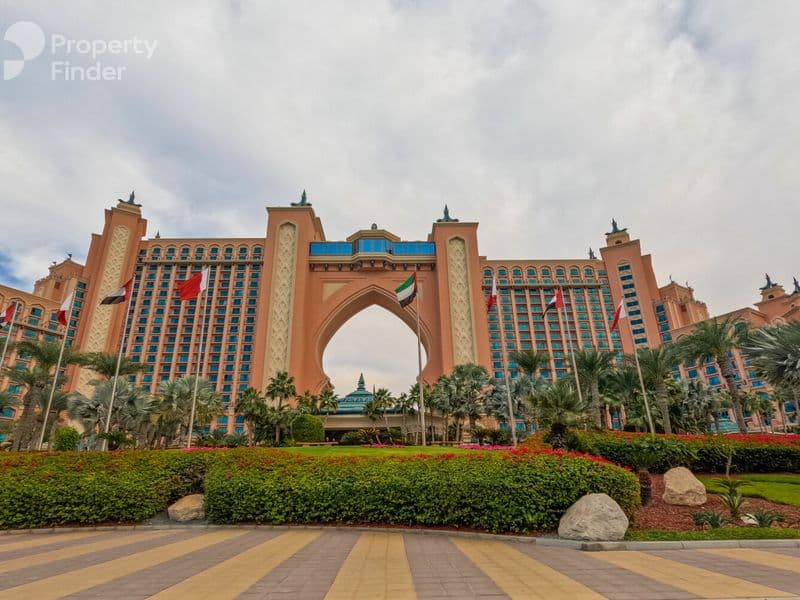
Dubai's climate is defined by long, sun-drenched winters and hot, humid summers. From October through April, temperatures are reliably warm and pleasant — typically between 20°C and 30°C — making outdoor living, beach access, and waterfront dining genuinely enjoyable for the better part of the year. Palm Jumeirah's position extending into the Arabian Gulf means residents benefit from sea breezes that temper the heat, and the island's private beaches are among the most accessible in the city. Summer months (June–September) bring temperatures above 40°C, during which residents tend to retreat to air-conditioned interiors, pools, and indoor leisure facilities.
The island is home to some of Dubai's most celebrated beachfront dining and leisure destinations. Nobu at Atlantis, Nammos Dubai, Coya, and a host of other internationally recognised restaurants and beach clubs are within minutes of most residences. The Palm's private beach clubs — including Drift Beach and Aquaventure Waterpark — offer residents and guests world-class facilities without leaving the island. Nakheel Mall on the Trunk provides everyday retail, a cinema, and a broad selection of casual and fine dining options.
Beyond the island itself, the Dubai Marina waterfront — one of the city's most vibrant urban districts — is a short drive or ferry ride away, offering further dining, nightlife, and leisure. The cultural institutions of Al Quoz, the galleries of Alserkal Avenue, and the historic Al Fahidi neighbourhood are all accessible within 20–30 minutes by car.
Dubai International Airport (DXB) is approximately 35–45 minutes from Palm Jumeirah by car, depending on traffic, and serves over 90 airlines with direct connections to virtually every major global city. Al Maktoum International Airport (DWC) in Dubai South is further afield but is earmarked for significant expansion. Within the city, the Palm Monorail connects to the Dubai Metro Red Line at Nakheel Mall, providing onward access to the broader network. The Palm Jumeirah Ferry Service links the island to Dubai Marina and Al Ghubaiba, offering a practical and scenic alternative to road travel. For daily errands and school runs, most residents rely on private vehicles or ride-hailing services such as Careem and Uber, both of which operate extensively across the island.
Palm Jumeirah's investment case rests on a foundation that few urban addresses can replicate: a fixed, finite supply of land in one of the world's fastest-growing cities. Unlike many Dubai submarkets where new supply is a constant variable, the Palm's footprint is set. This structural scarcity has historically supported price resilience and, during periods of strong demand, meaningful appreciation.
Dubai's broader residential market has experienced a sustained period of price growth since 2020, driven by an influx of high-net-worth residents, a post-pandemic reassessment of lifestyle priorities, and the UAE's proactive visa reforms — including the Golden Visa programme, which grants 10-year residency to investors meeting qualifying thresholds. According to Knight Frank's Dubai Market Review, prime residential values in Dubai rose significantly in recent years, with Palm Jumeirah consistently ranking among the top-performing submarkets for both capital values and transaction volumes.
Rental demand on Palm Jumeirah is underpinned by two distinct tenant profiles: long-term expatriate residents — particularly senior professionals and families — and short-term leisure visitors drawn by the island's hotel infrastructure and beach lifestyle. Dubai welcomed over 17 million international overnight visitors in 2023, according to the Dubai Department of Economy and Tourism, and the Palm's hotel and serviced apartment stock captures a meaningful share of premium leisure demand. This dual-market dynamic provides investors with flexibility: properties can be positioned for either the long-term rental market or the higher-yield (but more operationally intensive) short-term holiday home segment.
Currently available projects on Palm Jumeirah include apartments priced from AED 550,000 to AED 850,000, offering an accessible entry point into one of Dubai's most recognised addresses.
Dubai imposes no personal income tax, no capital gains tax, and no annual property tax on residential assets. A one-time 4% transfer fee is payable to the Dubai Land Department at the point of purchase. Short-term rental operators must obtain a Holiday Home licence from the Dubai Department of Economy and Tourism — a straightforward process that many investors manage through specialist operators. RERA (the Real Estate Regulatory Agency) provides robust consumer protections for off-plan buyers, including mandatory escrow accounts for developer receipts. These conditions collectively create a transparent, investor-friendly environment that compares favourably with most comparable global markets.
Yes. Palm Jumeirah is one of Dubai's designated freehold zones, meaning non-UAE nationals can purchase property with full ownership rights. This was established under Dubai Law No. 7 of 2006, which opened specific areas to foreign freehold ownership. Buyers receive a title deed registered with the Dubai Land Department (DLD), granting the same legal protections as any other freehold transaction in the emirate.
Yes. Short-term or holiday rentals in Dubai — including Palm Jumeirah — require a Holiday Home licence issued by the Dubai Department of Economy and Tourism (DET). Operators must also register each unit on the DET's platform. Failure to comply can result in fines. Many owners engage a licensed holiday home operator to manage compliance, listings, and guest services on their behalf.
Service charges on Palm Jumeirah vary by property type and building. Apartment buildings generally carry higher per-square-foot service charges than villa fronds, reflecting shared amenity costs such as pools, gyms, and concierge services. The Dubai Land Department's RERA Service Charge Index provides a publicly searchable benchmark for approved rates per community. Buyers should request the most recent service charge statement from the developer or seller before committing.
Several well-regarded international schools are within a short drive of Palm Jumeirah. Regent International School in The Greens follows the British National Curriculum, while Dubai British School in Jumeirah Park and GEMS Wellington International School in Al Sufouh are also popular choices for expatriate families. The American Curriculum is represented by schools in nearby Jumeirah and Al Barsha. School places in sought-after institutions can be competitive, so early registration is advisable.
Residents have access to several private clinics within the island itself, including Aster Clinic on the Palm. For more comprehensive hospital care, Mediclinic Parkview Hospital in Al Barsha and Saudi German Hospital in Al Barsha are among the nearest full-service facilities, both reachable within 15–20 minutes by car. Dubai's private healthcare sector is well-developed, and most employers and landlords expect residents to hold private health insurance.
The Palm Monorail connects the trunk of the island to Atlantis at the crescent, with a station linking to the Dubai Metro's Red Line at Nakheel Mall. The island's layout — a central trunk with radiating fronds — means villa residents typically rely on private vehicles or ride-hailing apps for daily errands, while trunk-based apartment dwellers enjoy better walkability to retail and dining. The Palm Jumeirah Ferry Service also connects the island to Dubai Marina and Al Ghubaiba, offering a scenic commute alternative.
Buyers should verify that the developer is registered with the Real Estate Regulatory Agency (RERA) and that the project has an escrow account — a legal requirement in Dubai protecting off-plan payments. Checking the project's construction status on the Dubai REST app or DLD portal is advisable before signing. Buyers should also scrutinise the Sales and Purchase Agreement (SPA) for handover timelines, penalty clauses, and post-handover payment plan terms, ideally with the assistance of a UAE-qualified legal adviser.
The UAE currently levies no personal income tax, no capital gains tax, and no annual property tax on residential real estate. A one-time 4% transfer fee is payable to the Dubai Land Department upon purchase, typically split between buyer and seller by convention (though this is negotiable). VAT at 5% applies to commercial property transactions but not to residential sales. These conditions make Dubai — and Palm Jumeirah specifically — particularly attractive to internationally mobile investors seeking tax-efficient structures.
Browse the full range of apartment listings on Palm Jumeirah, from trunk-based high-rises to crescent residences.
Explore waterfront frond villas offering direct beach access and unmatched privacy on the Palm.
Discover sky-level residences with panoramic Arabian Gulf views across the Palm's most prestigious towers.
A compelling middle ground between villa privacy and apartment convenience on Palm Jumeirah.
Compact, high-yield entry-level units ideal for investors targeting the short-term rental market.
Rare land opportunities for bespoke development on one of Dubai's most iconic addresses.